
Sleep and Recovery After 50: Why Rest Is Part of the Plan
Rest is not a prize you receive after you’ve worked hard enough. It is one of the conditions that helps you keep participating in daily life—whether that means walking, working, caring for someone, gardening, lifting groceries, managing a health condition, or learning a new activity.
That makes sleep and recovery after 50 part of the plan, not evidence that the plan has stalled. It also means recovery doesn’t need to become a project full of devices, perfect scores, supplements, or “anti-aging” promises. Ordinary recovery is less dramatic: making reasonable room for sleep, noticing how activity and life demands affect you, and responding without turning every signal into a diagnosis.
Sleep, rest, and activity recovery are connected—but not identical
Sleep is a biological need. Rest reduces demand without necessarily involving sleep. Activity recovery is the time and capacity between efforts. Easier movement, a pause between tasks, and a night in bed may all help, but they do different jobs.
Recovery needs also change. A demanding workweek, caregiving, pain, illness, emotional stress, travel, or a new activity can alter what is manageable. More effort is not automatically more useful, and choosing an easier version is not laziness.
No single sign tells the whole story. Soreness, fatigue, mood, coordination, and how ordinary tasks feel may offer useful observations, but they do not diagnose a sleep disorder, an exercise problem, or a medical cause. The same is true of resting heart rate and wearable sleep or “readiness” scores. A device estimate can be one data point if you find it helpful; it is not a verdict on your health, effort, or character.
Start with sleep opportunity and sleep quality
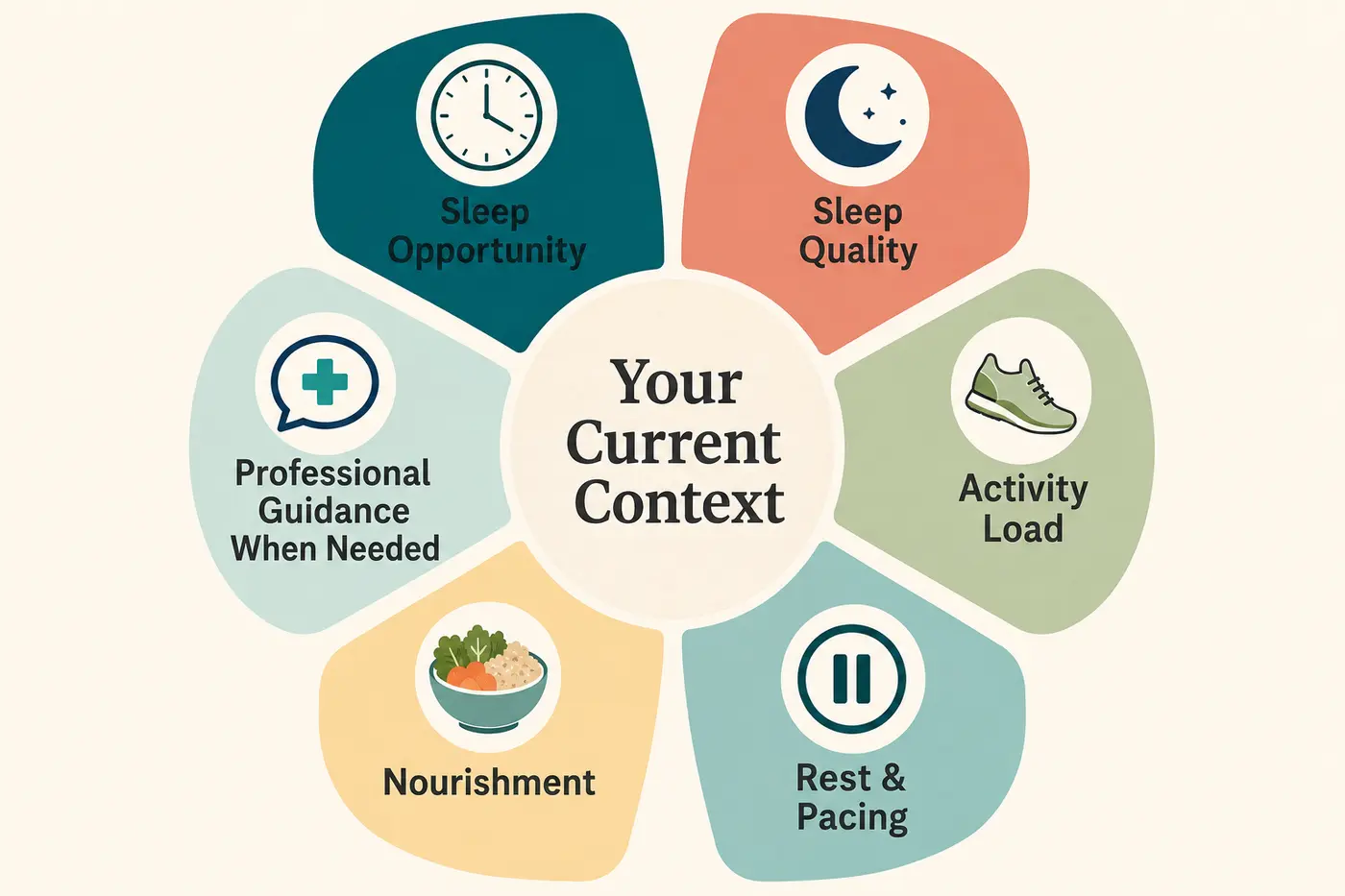
Sleep opportunity means the time and circumstances available for sleep. Sleep quality refers to how well that sleep goes. You can make room for sleep and still have difficulty falling asleep, wake repeatedly, or feel unrefreshed. That distinction matters because it keeps a difficult night from becoming a personal failure.
The CDC’s current age-banded sleep guidance recommends 7 or more hours a day for adults ages 18–60, 7–9 hours for ages 61–64, and 7–8 hours for adults 65 and older. These are population ranges, not a universal prescription or a promise that a certain number will leave any one person restored. The CDC also describes quality sleep as uninterrupted and refreshing—not simply time counted on a clock.
The broader NHLBI explanation of sleep deficiency includes not getting enough sleep, sleeping at the wrong time of day, poor-quality sleep, or a sleep disorder. This is useful context, not a checklist for identifying the cause of your own fatigue or sleep difficulty.
You cannot fully control sleep opportunity or sleep quality. Shift schedules, caregiving, pain, disability, housing, noise, shared rooms, menopause-related concerns, medication effects, stress, and other realities can narrow your options. The useful question is not “How do I produce perfect sleep?” It is “What, if anything, is workable here—and is there a persistent problem that deserves help?”
Build support around the life you actually have
The NHLBI’s healthy sleep habits include allowing enough time for sleep, keeping bedtime and wake time reasonably consistent, using quieter time before bed, and considering light, noise, temperature, caffeine, nicotine, alcohol, heavy meals, and physical activity. Those are options to assess, not a treatment guarantee or a demand to rebuild your entire evening.
Choose according to your circumstances. You might:
- Protect a little more sleep opportunity on nights when your schedule allows.
- Make the room darker, quieter, or more comfortable with curtains, an eye mask, earplugs, a fan, or a different arrangement—if these are safe, affordable, and compatible with other people in the space.
- Move caffeine earlier if you notice that later use seems to affect sleep, rather than adopting a universal cutoff.
- Create a short transition before bed, such as dimming a light, preparing what you need for morning, reading, listening to something calm, or using another familiar low-demand activity.
- Adjust screen brightness or content when that seems helpful without treating every screen as forbidden. A phone may also be an alarm, an accessibility tool, a source of connection, or necessary for caregiving or work.
These routine options aren’t a reason to use alcohol as a sleep aid or begin melatonin or another supplement. Questions about a medicine, supplement, menopause-related symptom, pain, or treatment that may affect sleep belong with an appropriate healthcare professional; do not change medication or treatment based on this article.
When work or caregiving sets the clock
A conventional nighttime schedule is not available to everyone. In training written for nurses working nights, CDC/NIOSH notes that protecting daytime sleep from light, noise, and interruptions may help. That narrow guidance is not a universal schedule; any approach still has to fit your job, commute, household, safety, and care responsibilities.
If you share a room or cannot control temperature or noise, a small personal change may be the realistic limit. If caregiving interrupts sleep, the problem is not a lack of discipline. Practical support from family, community services, an employer, or a healthcare team may matter more than another bedtime rule, though access to that support is not guaranteed.
Let activity and recovery inform each other
Recovery is not an athletic test, and age alone does not prescribe a number of rest days. Consider the whole load: exercise, physical work, household tasks, care work, travel, stress, symptoms, and sleep.
When you’re choosing or adapting activity, the beginner movement guide separates strength, aerobic activity, mobility, and balance without prescribing a universal workout.
After an unfamiliar or demanding activity, options may include repeating the same amount only when it feels manageable, choosing a shorter or easier version, changing the type of movement, spacing demanding efforts farther apart, or resting. Gentle movement may feel good to some people on an easier day; complete rest may be more appropriate at another time. Neither choice is a moral grade.
Pause the activity and seek appropriate guidance for new or worsening pain, breathlessness, dizziness, weakness, or another concerning symptom.
Notice patterns without treating them as proof. Questions might include:
- Are ordinary tasks feeling more manageable, about the same, or unexpectedly harder?
- Is soreness mild and settling, or is pain significant, worsening, or changing how you move?
- Is tiredness brief and understandable in context, or new, severe, persistent, or worsening?
Meals and fluids may be part of recovery, but no food, drink, or supplement guarantees recovery or fixes sleep. Follow individualized guidance you already have for health conditions, swallowing, fluid limits, blood sugar, or medication timing.
For flexible food ideas that keep those limits visible, the everyday meal-building guide uses adaptable combinations instead of rigid rules.
Know when routine adjustments are not enough
An occasional difficult night does not establish a disorder. However, persistent trouble falling asleep, staying asleep, or getting good-quality sleep despite having time and a suitable opportunity deserves a conversation with a healthcare professional. NHLBI’s overview of insomnia explains that a clinician may ask about sleep habits and use a sleep diary as part of an evaluation. That process is for assessment; the page is not a self-diagnosis tool.
Seek timely professional attention for loud, frequent snoring; observed breathing that starts and stops; gasping during sleep; severe daytime sleepiness; or other concerning symptoms. These features appear in NHLBI’s sleep apnea symptom guidance, but symptoms alone do not establish the diagnosis or its cause.
New, severe, persistent, or worsening fatigue warrants professional attention rather than dismissal as aging, laziness, or poor motivation. If you are too sleepy to drive or operate equipment safely, stop, move to a safe situation, and arrange another way to travel or get appropriate immediate help. Seek urgent help for severe symptoms or an immediate safety concern.
Make recovery a normal planning decision
Sleep cannot be forced into a perfect score, and recovery is not something you earn by exhausting yourself. A useful plan leaves room to respond to the person and the week in front of you.
If you want to place that action within a broader routine, the whole-body starting framework uses one need, one action, and one review point.
Choose one small action today: identify one realistic piece of sleep opportunity, environment, or activity load that you can protect or adjust this week. Make it an experiment in support—not a test you can fail.
Discover more from Your Whole Body Transformation
Subscribe to get the latest posts sent to your email.