
How to Begin a Whole-Body Transformation After 50—Without Trying to Change Everything at Once
Whole-body transformation after 50 doesn’t have to begin with a punishing workout, a restrictive eating plan, or a promise to become a different person by a certain date. A more useful beginning is quieter: decide what you want to feel easier or more supported in daily life, choose one action that fits your circumstances, and see what you learn.
That approach may not look dramatic. It can still be meaningful.
Perhaps you’d like to carry groceries with more confidence, feel steadier on uneven ground, make ordinary meals more reliable, protect time for recovery, or rebuild a routine after a long interruption. These are capability-based goals. They focus on what helps you participate in your own life, not how closely your body matches an image.
You also don’t need to address strength, mobility, balance, food, sleep, and habits all in the first week. These parts of health connect, but connection doesn’t require simultaneous overhaul. A workable transformation can begin with one need, one action, and one review point.
What “whole-body transformation” means after 50
Transformation is often marketed as rapid, visible, and complete. Real life is rarely so tidy. Bodies, schedules, resources, responsibilities, preferences, and health histories differ. They can also change from one season to the next.
For this approach, transformation means supporting daily capability, confidence, sustainable routines, and quality of life. Progress might include:
- Getting up from a favorite chair with more confidence
- Returning to an activity you value
- Preparing a reliable lunch on busy days
- Taking a walk that feels appropriate for you
- Making room for recovery instead of treating rest as failure
- Restarting a routine without trying to “make up” for missed days
These are examples, not promises or universal measures. Your useful signs of progress may look different.
Weight change may matter to some people for personal or clinical reasons, but it isn’t the definition of whole-body transformation. Neither is appearance. A number on a scale can’t fully describe steadiness, strength, confidence, sleep quality, nourishment, or how manageable your routine feels.
Start with the life you have now
Before choosing an action, name one everyday need that matters to you. Keep it concrete enough to guide a decision.
“Get healthier” is sincere, but broad. “I want the afternoon stairs to feel more manageable” gives you more information. So does “I want a dependable meal before my evening shift,” “I want to feel steadier when I step off a curb,” or “I need a calmer way to restart after a disrupted week.”
Then consider the conditions around that need:
- What time and energy are realistically available?
- What can you do safely where you live or work?
- Does weather or neighborhood safety affect outdoor movement?
- What food, transportation, equipment, storage, or cooking access do you have?
- Are pain, symptoms, medications, pregnancy, disability, balance concerns, an eating-disorder history, or a long period of inactivity relevant?
- Would qualified professional guidance help you choose or adapt the first step?
This isn’t a test of commitment. It is design information. A routine that ignores your actual circumstances isn’t more virtuous; it is simply less likely to fit.
Know when individualized guidance should come first
General health information can’t explain symptoms or determine whether a change is appropriate for you. Seek individualized guidance when a condition, medication, pregnancy, disability, eating-disorder history, balance concern, pain, or prolonged inactivity could affect safety. Appropriate support may come from a healthcare professional, physical therapist, qualified exercise professional, or registered dietitian.
If activity brings chest discomfort, fainting, severe or unusual shortness of breath, sudden weakness, or another alarming symptom, stop and seek prompt medical help. This article can’t determine the cause.
Persistent low energy, reduced capacity, pain, mobility changes, or poor sleep can have many possible influences. Don’t use a lifestyle checklist to diagnose yourself, and don’t start, stop, or change medication without guidance from the professional who manages it.
Choose one useful place to begin
Once you have a clear need and understand any safety considerations, choose the area most closely connected to it. You aren’t choosing the only part of health that matters. You’re choosing an entry point.
If daily movement is the clearest need
Federal physical-activity guidance is designed to help Americans maintain or improve health through movement. The current HHS guidance provides a public-health framework, while the CDC’s explanation of what counts as adult physical activity emphasizes that fitness levels differ, activity should fit a person’s abilities and health situation, and aerobic activity can be divided into smaller chunks.
Population guidance isn’t a personal first-week prescription. Your first action could be learning what movement is appropriate, making space safer, seeking an assessment, or trying a manageable amount of familiar activity.
For a closer look at adaptable options, the beginner movement guide explains how strength, aerobic activity, mobility, and balance fit together without turning them into a universal workout.
It’s also helpful to understand where age-specific guidance begins. CDC guidance for adults 65 and older includes aerobic, muscle-strengthening, and balance activities. That 65+ guidance should not be presented as though every detail automatically applies identically to every adult over 50. Your age, current ability, experience, goals, symptoms, and health circumstances all matter.
If regular, nourishing meals are the clearest need
You don’t need to turn eating into constant calculation. A useful first action might be keeping one dependable meal available or adding a food you enjoy to make a meal more complete.
If you want a practical next layer, this flexible guide to building everyday meals uses familiar foods and adaptable combinations rather than rigid menus.
MedlinePlus guidance on nutrition for older adults notes that needs can change with age and that adequate nutrients still matter even when energy needs differ. It recommends a varied eating pattern that includes fruits, vegetables, whole grains, protein-containing foods, and adequate fluids. That is general guidance, not a rigid menu or a universal calorie, protein, hydration, or portion prescription.
Work with the food traditions, budget, time, appetite, equipment, and access you have. Frozen, canned, prepared, repeated, and no-cook foods can all be practical. Seek individualized support if a condition affects eating or an eating-disorder history makes planning or tracking risky.
If sleep or recovery is the clearest need
Recovery isn’t a prize you earn after enough effort. It is part of a workable routine.
The sleep and recovery guide separates sleep opportunity, sleep quality, and everyday activity recovery so you can consider them without turning rest into another performance test.
The CDC’s overview of sleep distinguishes sleep duration from sleep quality and notes that sleep needs change with age. Its age bands are population guidance, not a guarantee that a particular number of hours will leave every person refreshed.
A modest first action might be protecting a realistic sleep opportunity or making one environmental adjustment. Shift work, caregiving, pain, housing, shared rooms, and other constraints can limit what is possible. Regular sleep problems or signs of a possible sleep disorder warrant professional guidance; a routine tip can’t diagnose or treat the cause.
If consistency and overwhelm are the clearest need
Make the routine smaller before you make it stricter.
Suppose you want to move more, improve meals, change your sleep schedule, and organize your week. Starting everything together can make it hard to tell what helped, what didn’t fit, and what became too much.
Choose the action that either supports the most important need or removes the clearest obstacle. Examples might include:
- Put walking shoes or a mobility aid where they’re easy to reach
- Add one familiar movement break to a part of the day that already has a cue
- Keep the ingredients for one dependable meal available
- Set up a calmer transition toward sleep on the nights when you control your schedule
- Make an appointment to get an individual concern assessed
These are editorial examples, not prescriptions. Adapt or discard them according to your situation.
Use one need, one action, one review point
The framework is simple on purpose.
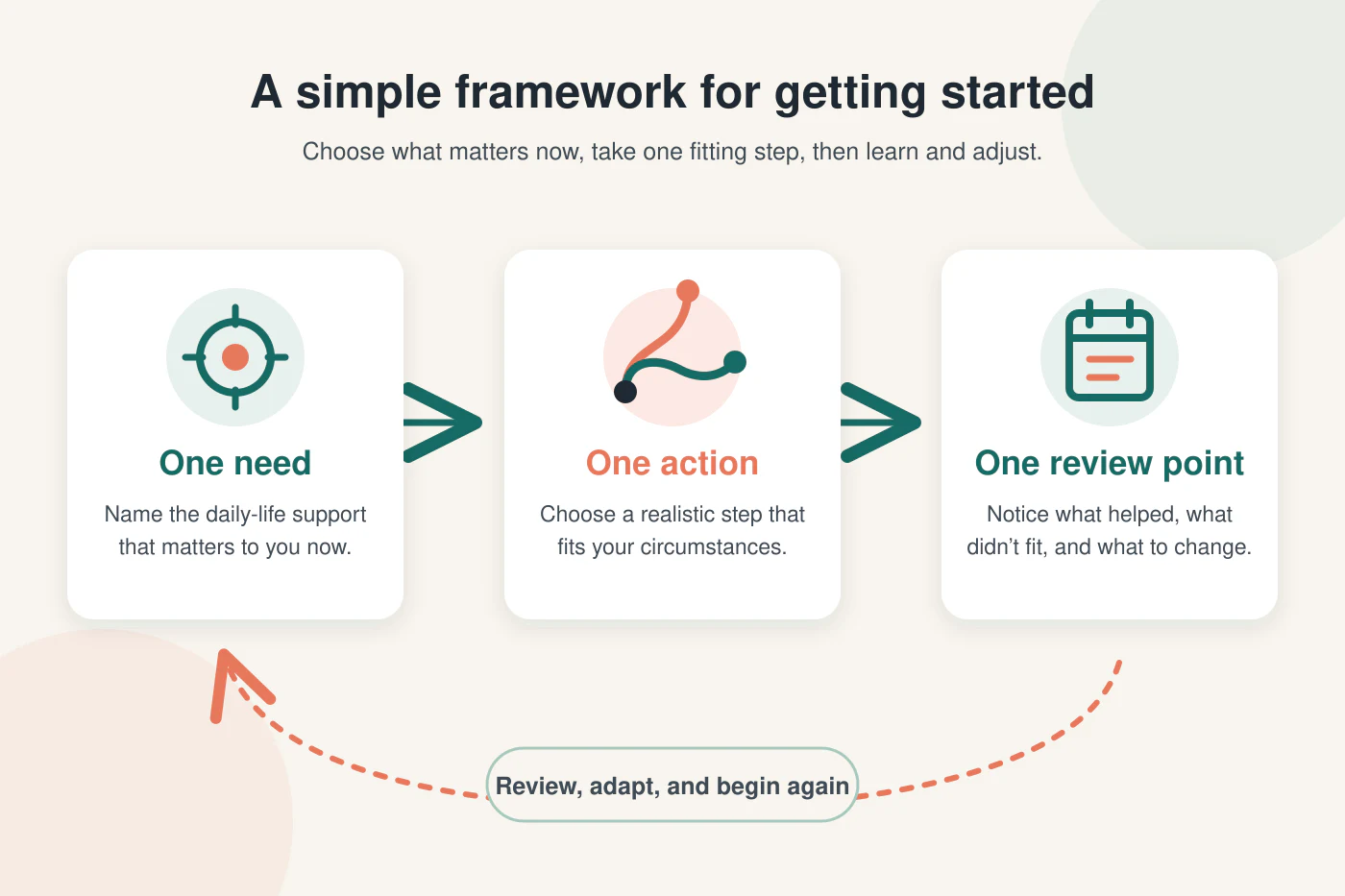
One need
Name the daily-life capability or support you care about now. “I want more confidence carrying ordinary items” is more useful than “I should get in shape.” “I need food available before a long shift” is more useful than “I should eat perfectly.”
The language matters because it changes the job of the routine. You aren’t punishing a body or proving discipline. You’re supporting something you want to do.
One action
Choose an action small and specific enough to attempt in your real circumstances. It should have a clear connection to the need, fit your current safety considerations, and leave room for adaptation.
An action isn’t better because it is harder. It is better when it is appropriate and useful.
If safety may be affected by prolonged inactivity, balance, pain, disability, pregnancy, medication, or a health condition, your first action may be getting individualized guidance. That is progress, not delay.
One review point
Choose a time to look back. The review point isn’t a deadline for visible transformation. It is a chance to ask:
- Did the action happen often enough for me to learn from it?
- Did it feel safe and manageable?
- What made it easier or harder?
- Did it support the everyday need I named?
- Should I maintain it, adapt it, replace it, or seek guidance?
Pick a review interval that makes sense for the action and your life. This framework doesn’t require a universal number of days.
Track signs of progress that relate to your life
Progress is easier to use when it connects to the reason you started.
If your need involved stairs, you might notice steadiness, comfort, or whether you still avoid them. For a dependable meal, notice whether food was available when needed and the process was manageable. For recovery, notice whether you allowed room for rest and whether persistent problems need professional attention.
Observations don’t prove cause and effect. Feeling different on a given day could reflect many influences. Treat your notes as information, not a diagnosis or a verdict.
Useful capability-based markers may include:
- How manageable a daily task feels
- Whether you can repeat the routine without it taking over your life
- Confidence using a skill or navigating an environment
- Whether the action fits your budget, schedule, access, and preferences
- How you respond when a week doesn’t go as planned
You don’t need to turn every marker into a score. A short note may be enough.
Build the next layer only when the first one fits
After your review point, you have more than two choices. You can add another action, but you can also maintain the current one, make it easier, change the cue, get help, or select a different starting point.
More isn’t always the right direction. A routine that works during a quiet month may need to shrink during travel, illness, caregiving, a demanding work period, bad weather, or a flare in symptoms. Adjusting to changed circumstances is part of sustainability.
If you miss several days or stop entirely, you haven’t erased what you learned. Ask what changed. Then choose a version that fits now, even if it looks smaller than the previous version.
Whole-body transformation after 50 can be steady without being rigid. Begin with one need that matters in daily life. Choose one action that respects your circumstances. Set one review point so you can learn and adjust. When that layer supports you, decide what—if anything—comes next.
The aim isn’t to win a transformation contest. It is to build support you can actually use.
Discover more from Your Whole Body Transformation
Subscribe to get the latest posts sent to your email.