
How to Increase Stamina After 50: A Gradual, Sustainable Approach
Stamina is the ability to keep doing an activity without becoming exhausted too quickly. It can matter when you walk through a store, climb stairs, work in the yard, travel, play with family, or simply move through a busy day.
Learning how to increase stamina after 50 does not require punishing workouts or trying to match someone else’s pace. A more useful approach is to practice manageable activity regularly, increase it gradually, and allow enough recovery for your body to adapt.
This article offers a flexible starting framework. It is general education, not individualized medical advice. If you have symptoms, a recent health change, or uncertainty about what is safe for you, speak with a qualified healthcare professional.
Start with the stamina you use in daily life
Stamina is often discussed as if it belongs only to runners or cyclists. In reality, daily endurance can show up in ordinary tasks: walking from a parking area, carrying groceries, standing while cooking, or completing household jobs with fewer rest breaks.
Choose one activity that is accessible and relevant to your life. Walking is common, but it is not the only option. A stationary bike, water exercise, seated marching, low-impact dance, or repeated short movement breaks may be more practical depending on your mobility, preferences, climate, equipment, and surroundings.
Your starting level does not need to look impressive. It only needs to be repeatable.
Use a comfortable baseline before adding more
For several sessions, notice how long you can do your chosen activity while maintaining controlled movement and a pace that feels manageable. During moderate activity, you should generally be able to talk, but not sing. This talk test is a practical guide, not a medical assessment.
Suppose eight minutes of walking feels manageable and leaves you reasonably recovered later that day and the next morning. That may be a better starting point than forcing a 30-minute session that causes excessive fatigue or makes you avoid the next workout.
Keep the first week deliberately modest. Consistency gives you better information about your true baseline than one unusually hard effort.
Build duration in small steps
Once your baseline feels steady, add a small amount of time to one or two sessions. For example, an eight-minute walk might become nine or ten minutes. You can hold that duration for several sessions before increasing again.
There is no universal weekly increase that suits everyone. Sleep, health conditions, medication changes, stress, heat, terrain, and other activity can all affect how a session feels. Increase only one main variable at a time—usually duration before speed or resistance—so you can tell how your body responds.
If one continuous session is not practical, split activity into shorter bouts. Three ten-minute walks across a day can be more manageable than one 30-minute walk. Shorter sessions still help you practice regular movement and may fit more naturally into work, caregiving, or household routines.
Balance activity with recovery
Recovery is part of building stamina, not evidence that you are failing. Your body needs time to respond to repeated activity.
A sustainable week may alternate more active days with easier movement or rest. An easier day could include a relaxed walk, gentle mobility work, or normal daily tasks rather than complete inactivity. The right balance depends on how you feel during activity, later that day, and the following day.
Pay attention to patterns rather than judging a single session. Mild temporary effort is expected. Persistent unusual fatigue, worsening pain, declining performance, or symptoms that interfere with normal activities are reasons to reduce the workload and seek appropriate guidance.
Sleep, regular meals, hydration, and enough overall energy also support recovery. No supplement, drink, or “energy” product can replace a tolerable activity plan and adequate rest.
Add strength to support everyday endurance
Cardiovascular activity and muscular strength are different, but they work together in daily life. Stronger legs and hips may make repeated standing, stairs, and walking feel more manageable. Upper-body strength can help with carrying and household tasks.
Simple options may include sit-to-stand practice, supported heel raises, wall push-ups, resistance-band rows, or other movements suited to your ability. Start with stable support and controlled repetitions. Avoid holding your breath.
You do not need to combine a hard strength workout with every stamina session. Two appropriately spaced strength sessions may fit alongside walking or other aerobic activity, with adjustments for your recovery and any professional advice you have received.
For a broader framework, YWBT’s guide to beginner exercise after 50 can help connect walking, strength, mobility, and balance without making one activity carry the whole plan.
Make progress visible without chasing perfect numbers
Tracking can be simple. Record the activity, approximate duration, and a short note about effort and recovery. You might use descriptions such as easy, manageable, challenging, or too much.
Useful signs of progress include:
- completing the same route with steadier effort;
- needing fewer or shorter rest breaks;
- adding a few minutes without a large increase in fatigue;
- recovering more comfortably by the next day; or
- finding routine tasks less tiring.
Step counts, heart-rate data, and fitness watches are optional. They can be useful for some people, but device estimates are imperfect and should not override symptoms or individualized medical guidance.
Plan for interruptions
Illness, travel, poor sleep, caregiving, weather, and busy periods can interrupt a routine. A break does not erase all progress, and it does not require a dramatic comeback.
After time away, restart below your previous workload and assess how you respond. The longer the interruption or the more significant the health change, the more conservative the restart should be.
It can also help to keep a “minimum version” of your routine: perhaps five minutes of indoor walking, seated marching during a television break, or one short trip around the block. A minimum is not a punishment. It is an option for maintaining the habit when a full session is unrealistic.
Know when to pause and get guidance
Stop activity and seek prompt medical guidance if you experience chest pain or pressure, fainting, severe or unusual shortness of breath, a new irregular or racing heartbeat, sudden weakness or numbness, or another alarming symptom. Emergency symptoms require emergency care.
Ask a qualified clinician about an appropriate starting plan if you have a known heart or lung condition, poorly controlled blood pressure, recent surgery or hospitalization, unexplained dizziness, a recent fall, or symptoms that appear with exertion. Medication can also affect heart rate, balance, heat tolerance, and perceived effort. The National Institute on Aging also offers practical guidance on exercise types and safe activity for older adults.
General public-health guidance encourages adults to work toward a combination of aerobic and muscle-strengthening activity, while emphasizing that some activity is better than none and that activity can be accumulated over time. Those population-level recommendations are a destination, not a requirement to begin at the full amount.
A practical four-week example
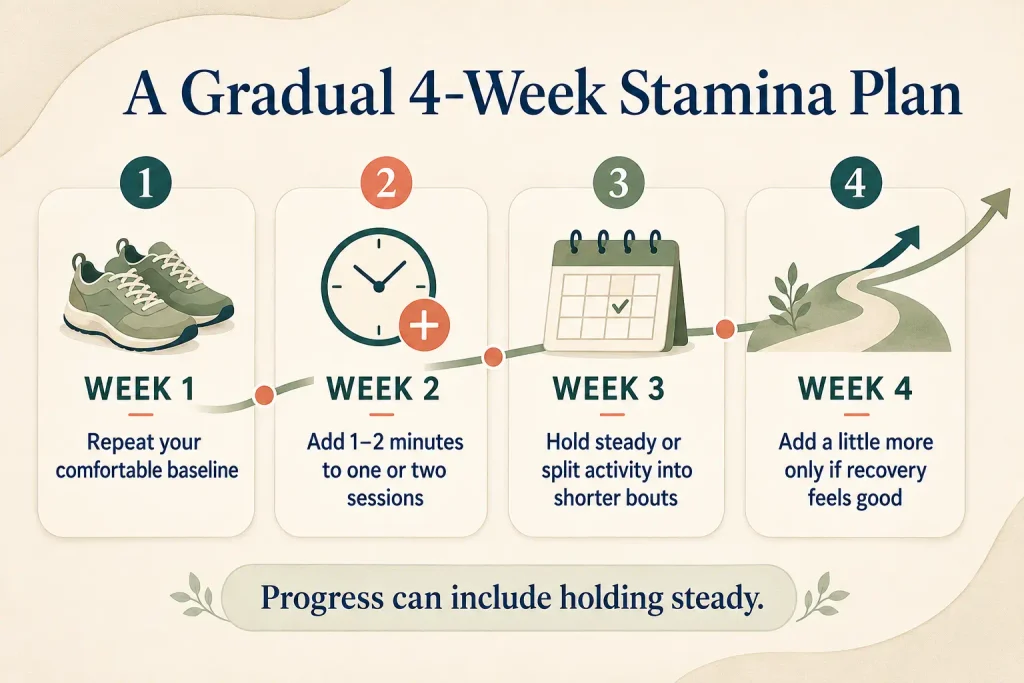
This example is intentionally flexible and assumes the starting duration already feels manageable:
- Week 1: repeat the baseline duration on several nonconsecutive or comfortably spaced days.
- Week 2: add one or two minutes to one or two sessions.
- Week 3: hold the new duration steady, or split it into shorter bouts if needed.
- Week 4: add another small amount only if effort and next-day recovery remain acceptable.
If a week feels too difficult, repeat the previous week or reduce the duration. Progress is not invalidated by holding steady.
For readers building a broader wellness routine, these balance exercises for adults over 50 offer a safe, supported next step without turning stamina into an all-or-nothing project.
Build from repeatable effort
The most useful stamina plan is one you can recover from and return to. Start with an activity that fits your body and circumstances, establish a comfortable baseline, add time in small steps, and treat recovery as part of the plan.
You do not have to prove your fitness in a single workout. Repeated manageable effort is the work.
Discover more from Your Whole Body Transformation
Subscribe to get the latest posts sent to your email.