Balance Exercises for Adults Over 50: A Safe, Supported Start
Balance helps you stay steady while standing, changing direction, reaching, and moving through everyday life. It is not only a concern for people who already feel unsteady. Giving balance some attention after 50 can support confidence and coordination alongside strength, mobility, and regular aerobic activity.
You do not need impressive poses or complicated equipment to begin. Balance exercises for adults over 50 can start with small, supported movements beside a sturdy counter or a chair that cannot slide. The goal is to practice with enough challenge to pay attention while keeping the setting controlled and adaptable to your current abilities.
What balance training can—and cannot—do
Balance is the ability to maintain stability while you are still or moving. It depends on several systems working together, including vision, sensation, strength, joint mobility, and the brain’s ability to organize movement. Practice can give those systems opportunities to coordinate under manageable conditions.
Balance work may help reduce falling risk, but it cannot guarantee that a person will never fall. Floors, lighting, medications, vision, illness, footwear, and unexpected obstacles can all affect safety. Exercise also cannot diagnose the reason someone feels dizzy or unstable, and it does not replace individualized medical or physical-therapy care.
Balance fits best within a broader approach to movement. The CDC’s activity guidance for adults 65 and older includes aerobic, muscle-strengthening, and balance activities, and it emphasizes choosing activity that suits the person’s abilities. That specific recommendation is written for adults 65 and older; someone in their 50s can still consider balance practice as one part of a well-rounded routine without treating the 65-plus guidance as a universal prescription.
If you are also building a broader movement routine, this beginner’s guide to strength, walking, mobility, and balance after 50 explains how those pieces can complement one another.
Set up for safety before you begin
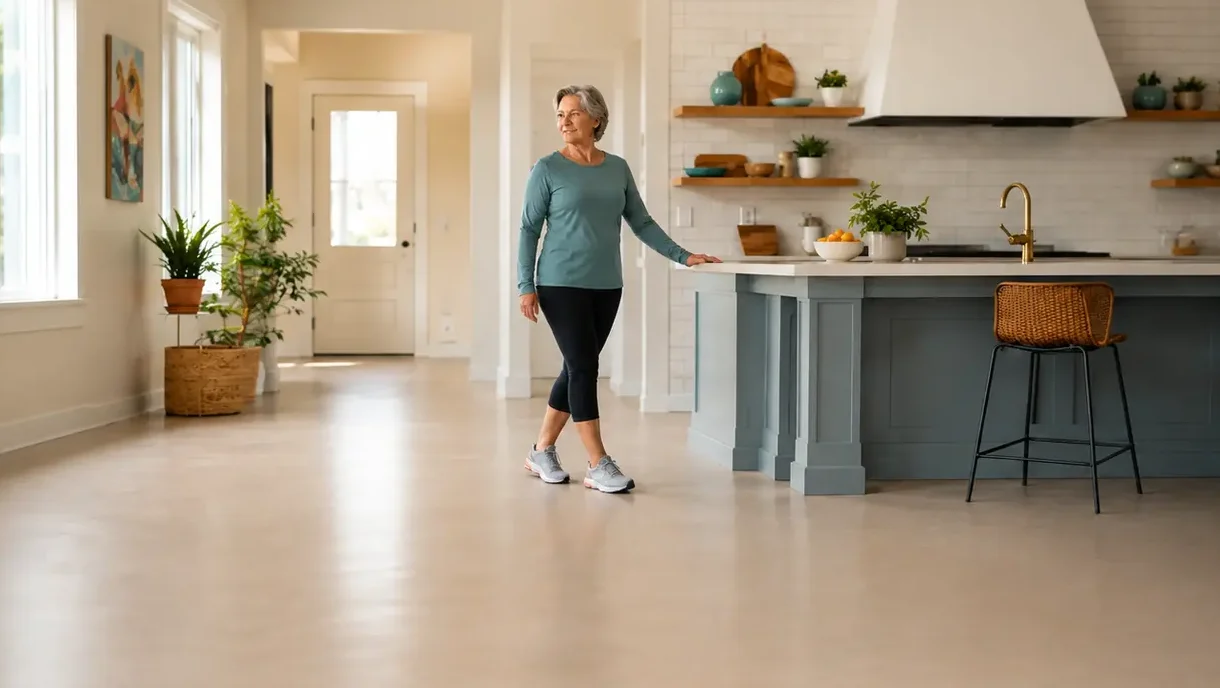
Choose a clear, well-lit area with a nonslip floor. Keep a sturdy counter within easy reach, or use a solid chair positioned so it cannot slide or tip. Avoid relying on a lightweight folding chair, rolling furniture, or a towel rack. Wear suitable, secure footwear when appropriate for you and the surface.
Begin with a comfortable posture and breathe normally. Move within a range you can control. It is reasonable to keep one or both hands on the support, make the movement smaller, or stop sooner than an example suggests. Support is a sensible training tool, not a sign that you are doing the exercise incorrectly.
Stop if you have pain, dizziness, chest discomfort, unusual shortness of breath, or a feeling that you cannot remain steady. Seek individualized guidance from a qualified clinician or physical therapist if you have had a recent fall, significant dizziness, new weakness or numbness, major vision changes, or a condition that affects balance. If you are returning after a break, restart at a lower level and build gradually. People with health conditions can ask their clinician whether the condition limits activity and what kind of plan is suitable.
Seven practical supported balance exercises
These are adaptable examples rather than a universal workout or medical treatment. Select only the movements that feel appropriate today. A short period of calm, controlled practice is more useful than forcing a difficult variation.
1. Side-to-side weight shifts
Stand facing a counter with your feet at a comfortable width and both hands resting lightly on the surface. Slowly shift more of your weight toward one foot without lifting the other foot. Return to the center, then shift toward the other side. Keep your torso tall and make the shift as small as needed. Notice the pressure changing under each foot rather than trying to travel far.
2. Supported marching
Hold the counter and lift one foot a comfortable distance from the floor. Set it down with control, then change sides. The movement can be very small. Try to avoid rushing or leaning heavily from side to side. If alternating feet feels uncertain, practice several gentle lifts with one foot before switching.
3. Heel-to-toe stance
Stand beside a counter and place one foot slightly ahead of the other, as though your feet were on two nearby tracks. If that feels steady, narrow the space between the tracks or bring the heel of the front foot closer to the toes of the back foot. Keep a hand on the support. Change which foot is forward. There is no need to force a perfectly straight line.
4. Supported single-leg stance
With both hands on a stable surface, shift your weight onto one leg and let the other foot become light. You might keep the toes touching the floor like a kickstand or lift the foot slightly. Stand tall without locking the supporting knee, then change sides. Standing on one foot is also listed as a balance example in public-health guidance, but using support is a practical way to make the starting version safer.
5. Sit-to-stand
Sit toward the front of a firm chair that will not move. Place your feet where they feel supportive. Lean forward from the hips and stand using your hands on the chair or a nearby stable surface if needed. Pause, then sit down slowly. This movement develops leg and trunk strength that can support balance. Use a higher seat or more hand assistance if that makes the motion comfortable and controlled.
6. Supported heel raises
Face the counter with your feet comfortably apart. Keep both hands supported as you lift your heels and rise toward the balls of your feet. Lower slowly. Choose a small lift if that is easier to control. Avoid rolling toward the outer edges of your feet or using momentum to bounce.
7. Gentle multidirectional stepping
Stand at a counter and take a small step to the side, then return to your starting position. Repeat on the other side. If that is comfortable, practice a small forward step and return. A backward step can be added only when you can see and control the space and remain securely supported. Do not use unsupported backward walking as a beginner home exercise.
The CDC’s overview of what counts as activity for older adults mentions walking backward, standing on one leg, and wobble boards as balance examples, while also noting that back, abdominal, and leg strengthening supports balance. That does not mean every example belongs in a beginner home routine. A wobble board and unsupported backward walking add instability and are better left out unless a qualified professional recommends and supervises them.
A simple, flexible way to start
Choose two or three exercises rather than trying all seven at once. You might practice for a few comfortable repetitions or a brief period, rest, and decide whether another round feels useful. Optional starting examples could be three to five controlled weight shifts per side, several supported marches, or a supported stance held for a few calm breaths. These are examples, not required targets.
Practice on days and at times when you are alert and not rushed. A few minutes attached to an existing routine—after a walk, before lunch, or while waiting for the kettle—may be easier to sustain than a large standalone session. The National Institute on Aging’s discussion of balance and other types of exercise suggests aiming for balance exercise around three times per week and includes tai chi, yoga, and standing on one foot as examples. Treat that frequency as general guidance, not a requirement to push through symptoms or ignore your own recovery needs.
It may help to note what support you used and how steady the movement felt. That gives you a practical reference without turning the session into a test. For a broader approach to starting small, see this guide to beginning a whole-body transformation after 50.
Progress without rushing
Progress by changing only one variable at a time. You could use slightly less hand pressure, narrow your stance a little, make one step marginally longer, add a small amount of time, or introduce a gentle head turn while remaining supported. Keep everything else familiar while you test that one change.
More difficult is not automatically more useful. Closing your eyes, standing on an unstable object, combining several challenges, or moving farther from support can sharply increase risk. Those variations are not necessary for a productive beginner practice. If a progression causes gripping, breath-holding, hurried corrections, or repeated loss of position, return to the previous version.
Balance can vary from day to day because of sleep, stress, illness, pain, medication effects, or fatigue. Adjusting the session is part of sustainable training. Using more support today does not erase earlier progress.
When professional guidance is appropriate
A clinician or physical therapist can help identify which factors may be affecting balance and tailor exercises to your health, medications, vision, sensation, strength, home environment, and goals. Professional input is especially important after recent falls or when dizziness, new weakness or numbness, major vision changes, or a known condition affects stability.
You do not have to wait for a crisis to ask for help. Guidance can be useful when you are unsure which support is appropriate, cannot find a starting variation that feels secure, or want to progress beyond basic supported movements.
A steadier start can still be a small start
Balance practice does not need to look dramatic. A few attentive weight shifts at the counter or controlled stands from a sturdy chair can be a meaningful beginning. Choose a safe setup, keep the movement comfortable, and let consistency grow from what fits your life.
Pick one supported exercise to try when you feel well and unhurried. Notice how it feels, make only one adjustment at a time, and seek qualified guidance whenever symptoms or uncertainty make independent practice inappropriate.
Health disclaimer: This article provides general educational information and is not medical advice, diagnosis, or treatment. Individual abilities and health needs vary. Consult a qualified health professional for guidance appropriate to your circumstances, especially if you have symptoms, recent falls, or a condition that may affect balance or exercise safety.
Discover more from Your Whole Body Transformation
Subscribe to get the latest posts sent to your email.