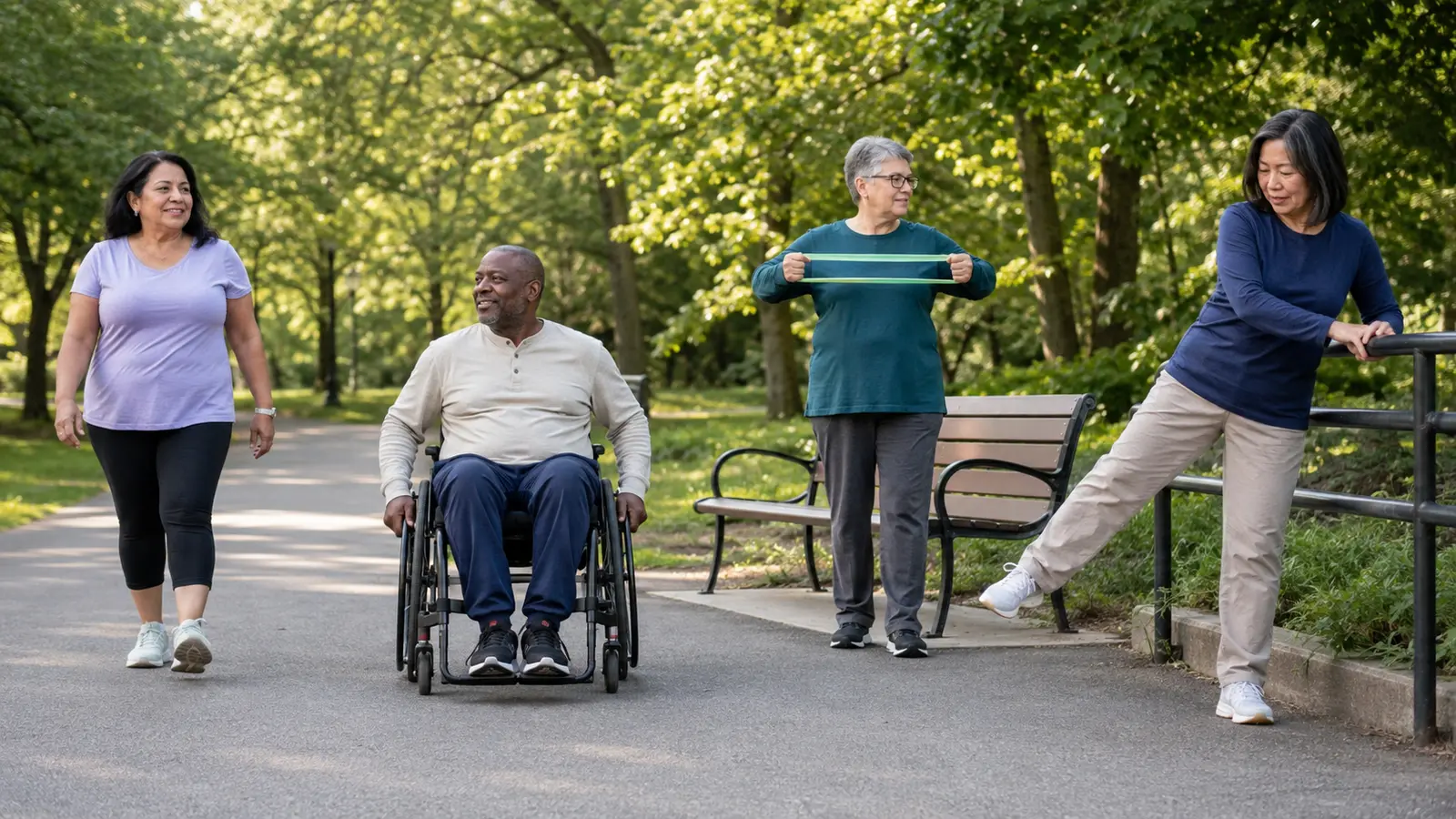
A Beginner’s Guide to Strength, Walking, Mobility, and Balance After 50
There isn’t one correct way to begin exercising after 50. You may be starting structured activity for the first time, returning after years away, or adjusting something you already know well. Your current ability, health, interests, environment, and priorities matter more than an age-based stereotype.
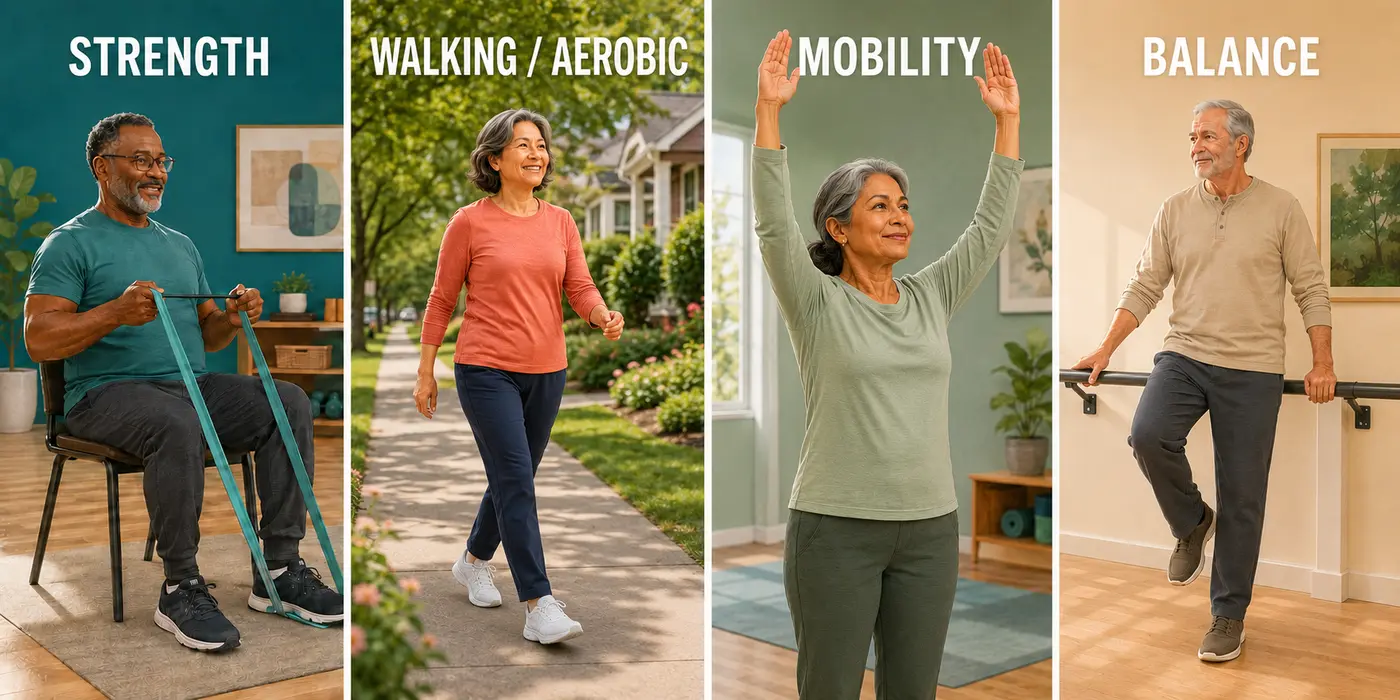
A useful approach to beginner exercise after 50 is to understand four parts of movement: strength, walking or other aerobic activity, mobility, and balance. They overlap, but they don’t do identical jobs. You don’t need to master all four at once, and you don’t need a universal workout to begin making thoughtful choices.
If movement is only one part of what you want to support, the whole-body starting framework can help you choose one need, one action, and one review point.
Four kinds of movement, four different jobs
Strength helps you produce force
Strength is the ability to produce force against resistance. In daily life, that might show up when you stand from a chair, carry groceries, lift a suitcase, push a door, garden, or transfer between a wheelchair and another surface.
Resistance can come from your body, a wall, a resistance band, a machine, a handheld weight, a household object, or assistance from another person or device. The right option is the one you can use with control and that suits your circumstances. Strength work isn’t reserved for gyms, and it doesn’t have to be framed around appearance.
Walking and other aerobic activity build sustained movement
Aerobic activity is movement that raises your breathing and heart rate. Walking is accessible and enjoyable for many people, but it isn’t the only choice. Cycling, swimming, water exercise, dancing, wheeling, and some seated movement can also be aerobic when they create sustained effort.
This category supports your ability to keep moving over time. A walk may also involve leg strength, mobility, and balance, but walking alone doesn’t automatically provide every kind of challenge those capacities need. Likewise, a person who doesn’t walk can still pursue aerobic activity through an option that fits their body and equipment.
Mobility gives you usable movement options
Here, mobility means being able to move through a range that’s useful and comfortable for a task. Reaching overhead, turning to look behind you, bending an ankle as you step, or opening the hips enough to get into a car all involve mobility.
Mobility practice may include gentle joint movement, position changes, or stretching. It isn’t a promise to “fix” posture, pain, or a joint. More range isn’t always the goal; useful range with control may matter more. If a movement produces pain or conflicts with a medical or rehabilitation plan, an individualized assessment is more appropriate than forcing the position.
Balance is the work of staying steady
Balance is your ability to control your position while still or moving. It changes with the task and surroundings: turning, stepping over a curb, moving on an uneven path, or reaching outside your usual base of support can all ask something different of you.
Balance practice should create an appropriate challenge, not a test of nerve. A stable counter, sturdy rail, wall, mobility aid, or qualified person can be part of good practice. If you’re unsteady, have fallen, fear falling, or don’t know what level of challenge is suitable, seek individualized guidance before trying unsupported drills.
Start with your current ability
Before choosing activities, take stock without grading yourself. What movement already happens in your day? Which tasks feel comfortable and controlled? Where do pain, fatigue, breathlessness, steadiness, access, or confidence change what’s practical? Is there an everyday capability you’d particularly like to support?
Current ability can vary from day to day. Sleep, illness, work, caregiving, weather, symptoms, and recovery all affect what’s workable. That information helps you adapt; it isn’t evidence that you’ve failed.
If you’ve been inactive for a prolonged period, begin conservatively and consider whether individualized guidance would help you choose an entry point. The same applies when concerning pain, a chronic condition, disability, balance concerns, or medication effects may influence activity. A physical therapist can assess movement and adaptations; a clinician can address medical questions; and a qualified exercise professional can help translate appropriate guidance into activity choices. If pregnancy or the postpartum period is relevant, CDC offers activity guidance for generally healthy people and advises consultation about adjustments; personal clinical guidance matters when complications or other circumstances fall outside that limited scope. Age alone doesn’t determine whether someone needs professional input.
What public-health guidance says—and what it doesn’t
The current federal Physical Activity Guidelines provide population-level guidance, not a personal exercise prescription.
For adults, including adults ages 50–64, CDC’s adult activity overview summarizes the guideline as at least 150 minutes of moderate-intensity aerobic activity a week, or 75 minutes of vigorous activity, or an equivalent combination, plus muscle-strengthening activity on at least two days. It also emphasizes that some activity is better than none and that activity can be spread across the week.
For adults 65 and older, CDC’s older-adult guidance includes the same aerobic and muscle-strengthening categories and adds balance activities. It also says activity should reflect a person’s abilities and conditions. The balance recommendation is specifically presented for the 65-and-older population; it shouldn’t be misquoted as an age-50 threshold. Someone ages 50–64 may still have a practical reason to work on balance, especially if a qualified assessment identifies one.
These targets describe a health-supportive destination for populations. They don’t tell you what is safe today, define a required first week, guarantee a result, or account for your symptoms, condition, medication, pregnancy, disability, or history. You don’t have to turn the numbers into a deadline.
Intensity is also personal. CDC notes in its explanation of what counts as adult physical activity that the same walk may feel moderate to one person and vigorous to another, depending on fitness, comfort, health, and ability. That’s why someone else’s pace, heart rate, step count, or distance isn’t automatically a useful target for you.
Build a movement menu, not a rigid workout
Think in choices. You might select from one or more parts of this menu as your interests and circumstances allow. These are examples, not a prescribed session.
For aerobic movement: consider walking indoors or outside, wheeling, dancing, water activity, cycling, or continuous seated movement. A hallway, community center, pool, home video, or piece of equipment may be more workable than a sidewalk. Smaller chunks of aerobic activity can count toward the public-health total, but their length and frequency remain yours to individualize.
For strength: consider controlled pushing, pulling, carrying, standing, stepping, or other resistance-based patterns appropriate to your ability. Those patterns can be adapted with a chair, wall, band, machine, weight, household object, mobility aid, or assistance. A seated option isn’t a lesser version; it’s one way to match the task to the person.
For mobility: consider comfortable joint movements or position changes that relate to something you want to do—such as reaching, turning, or taking a comfortable step. Move within a useful range rather than chasing a dramatic stretch. Mobility can appear in a warm-up, between other activities, or on its own.
For balance: consider only challenges you can set up safely, with stable support close enough to use. Balance may be practiced while seated, during transfers, while standing with support, or through carefully selected stepping and reaching tasks. Mobility aids should be used as directed; don’t set one aside merely to make an exercise harder.
You can also combine categories. Dancing may be aerobic while asking for balance and coordination. Moving from sitting to standing may involve strength, mobility, and balance. Categories help you notice what a choice offers; they’re not boxes you must keep separate.
Make the environment part of the decision
An activity that looks simple on paper can change with the setting. Check for loose rugs, clutter, poor lighting, wet or uneven surfaces, pets, traffic, or anything else that could interfere. Keep stable support available for transfers or balance work, and choose footwear or other foot support suited to you, the activity, and the surface.
For outdoor movement, consider heat, cold, rain, ice, air quality, daylight, traffic, and neighborhood safety. An indoor route or seated alternative can be a sound adjustment, not a consolation prize. Bring and use any mobility aids that are part of how you move safely.
Cost and access matter too. Free or low-cost home and community options can be legitimate choices. Conversely, supervision or specialized equipment may be worth pursuing when it makes activity accessible and safer.
Progress means adapting, not always adding
Gradual progress lets you learn how an activity affects comfort, control, symptoms, and recovery. Change one feature at a time—such as the activity, resistance, duration, range, complexity, or environment—so you can make sense of the response. That principle isn’t a schedule or a command to advance. Maintaining the same level, choosing a smaller version, or resting can be the wiser decision.
Effort can feel unfamiliar, but an article can’t determine whether discomfort is harmless or what causes a symptom. Pause if pain is new, sharp, severe, worsening, changes how you move, or otherwise concerns you. Stop if you experience dizziness, chest discomfort, unusual shortness of breath, faintness, loss of control, or another new concerning symptom. The National Heart, Lung, and Blood Institute specifically advises talking with a doctor about chest pain or dizziness during physical activity. Seek urgent or emergency help for severe or urgent symptoms rather than trying to exercise through them.
After an injury, fall, major health change, or substantial interruption, reassess instead of automatically resuming where you left off. Pain that persists or meets the concerning thresholds above deserves appropriate professional attention.
Adults with chronic conditions or disabilities can be active, but the right types and amounts may need individualization. CDC recommends consulting a healthcare professional or physical-activity specialist about appropriate activity when chronic conditions or disabilities are relevant. Ask about medication effects if they may change balance, alertness, heart rate, blood pressure, blood sugar, heat tolerance, or another exercise consideration; don’t change medication on the basis of an article.
Meals and recovery belong in the same picture
Movement doesn’t need to earn food, and food isn’t payment for exercise. Regular meals and fluids help meet ordinary nourishment needs around an active life, but no single meal guarantees strength, energy, or recovery. Choose foods and timing that fit your appetite, culture, budget, access, health needs, and any individualized nutrition guidance. If activity affects blood sugar, digestion, swallowing, appetite, or medication timing, ask the appropriate clinician or registered dietitian for tailored advice.
For ordinary food ideas rather than an exercise-fueling prescription, see the flexible guide to everyday meals for strength and energy.
Recovery includes time between demanding efforts, sleep, and adjustment when life is taxing. CDC’s overview of sleep notes that good sleep is not only about hours; quality matters too, and ongoing sleep problems warrant a conversation with a healthcare provider. Rest doesn’t have to be justified, and fatigue shouldn’t automatically be blamed on age or lack of willpower. New, severe, or persistent fatigue deserves appropriate attention.
For more context on rest between efforts, sleep opportunity, and sleep quality, read the practical guide to sleep and recovery after 50.
Choose a next step that belongs to you
A balanced approach to movement can include strength, aerobic activity, mobility, and balance without making every day look the same. Begin with current ability. Choose an option that fits your purpose and setting. Notice comfort, control, symptoms, and recovery. Adapt when the information changes.
Public-health guidelines can show the broad shape of an active life, but they can’t know your body or circumstances. The most useful beginning may be an activity you can try safely, a professional assessment, or a conversation that helps you understand your options. Each is a legitimate way forward.
Discover more from Your Whole Body Transformation
Subscribe to get the latest posts sent to your email.